
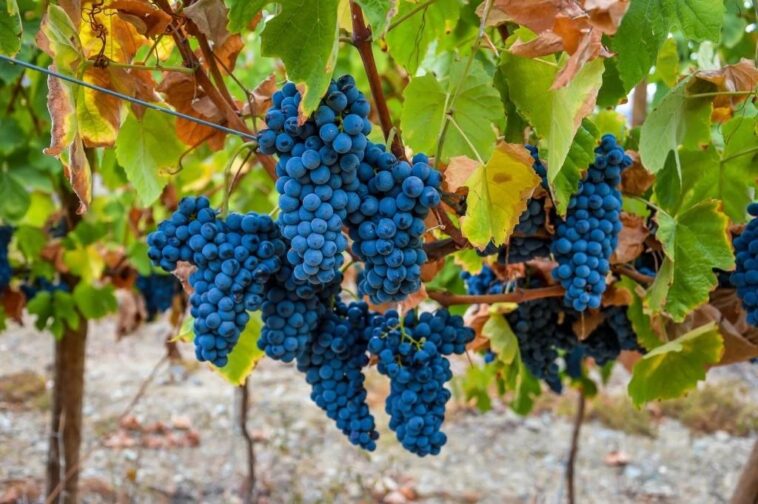
If you start exploring Portuguese red wine, Touriga Nacional is a name you will meet quickly.
It is one of Portugal’s best-known native red grapes, strongly associated with the Dão and Douro, and it also plays an important role in the production of Port.
Yet knowing the name does not mean you know exactly what the wine will taste like.
- That is part of what makes Touriga Nacional interesting. The grape has a recognizable character, but the place where it grows can change the result considerably. A wine from the granite soils and higher vineyards of the Dão can feel very different from one grown on the hot, schist slopes of the Douro.
For anyone who wants to explore the grape in more depth, Secret Cellars has a detailed guide to Touriga Nacional, including its history, taste profile and examples from different parts of Portugal.
What Makes Touriga Nacional Distinctive?
Touriga Nacional produces small berries with relatively thick skins and naturally modest yields. That combination gives winemakers plenty of color, tannin and aromatic material to work with. It is one reason the grape can produce wines with both concentration and long ageing potential.
The aromas are often just as important as the structure. Violet is one of the notes most often associated with Touriga Nacional, alongside blackberry, blackcurrant, plum, herbs and spice. Depending on the vineyard and winemaking, the wine may feel floral and elegant or much darker and more powerful.
However, I would be careful with any tasting description that makes the grape sound too predictable. Wine is never only the grape variety. Altitude, soil, exposure, rainfall, temperature, harvest timing and decisions in the cellar all influence what eventually reaches the glass.
That is why tasting one Touriga Nacional does not really tell you what all Touriga Nacional tastes like. It tells you what that grape did in one place, in one vintage, under one producer.
Dão and Douro: Two Important Homes
The Dão and Douro are the two regions most closely connected with Touriga Nacional. Both have a strong historical claim to the grape, and both show why regional context matters.
In the Dão, many vineyards sit at altitude and granite is common. Mountains surround much of the region, while cooler nights can help the grapes retain acidity. As a result, Touriga Nacional from the Dão can show floral aromas, fresh dark fruit and a firm structure without necessarily feeling heavy.
The Douro gives a different starting point. Its steep vineyards, schist soils and generally warmer, drier conditions can produce more concentrated expressions. Touriga Nacional is also an important component in Port blends, although today it is increasingly familiar as a dry red wine as well.
These descriptions are useful, but they are not rules. A high-altitude Douro vineyard can produce a surprisingly fresh wine, while a warmer site in the Dão may give a richer expression. Even two nearby vineyards can behave differently.
That regional diversity becomes clearer when you look beyond one grape. Secret Cellars’ guide to the Portuguese wine regions is a useful starting point because it shows how climate, soil and local grape varieties change as you move through the country.
More Than a Port Grape
For many international wine drinkers, Touriga Nacional first appears through Port. That connection matters, because the grape contributes color, perfume, tannin and structure to some of the Douro’s most important fortified wines.
Still, stopping at Port misses a large part of the story.
Single-variety Touriga Nacional has become much easier to find, while producers across Portugal also use it in dry red blends. In the Dão, for example, it can appear alongside varieties such as Alfrocheiro, Jaen and Tinta Roriz. In the Douro, it commonly blends with Touriga Franca, Tinta Roriz, and other traditional grapes.
Tasting a varietal Touriga Nacional can be particularly useful if you are learning about Portuguese wine. It gives you a chance to recognize its floral character, tannin and dark fruit before tasting the grape again as one part of a blend.
At the same time, the growing number of varietal wines makes regional comparison more interesting. You can taste the same grape from different areas without pretending that one region represents the “correct” version.
Why Touriga Nacional Can Age So Well
Structure is one of Touriga Nacional’s strengths. The combination of tannin, acidity, color and fruit concentration gives well-made examples the ability to develop in bottle.
Young wines can be strongly floral and fruit-driven. With age, those primary aromas may move toward dried flowers, tobacco, spice, leather and more savory notes. Oak aging can add another layer, although the amount and type of oak depend entirely on the producer.
Not every bottle is designed for decades of aging, of course. Some producers aim for a softer style that can be enjoyed earlier. Nevertheless, if a wine has enough fruit, acidity and tannin, Touriga Nacional provides a strong foundation for development.
This also explains why the grape works so well in blends. It can contribute structure and perfume without dominating the entire wine.
What Should You Eat With Touriga Nacional?
Food pairing depends on the wine’s style, but Touriga Nacional usually has enough structure to pair well with richer dishes.
A concentrated version can work very well with grilled or slow-cooked meat, game, duck, or mature cheese. The protein and fat soften the perception of tannin, while the wine has enough flavor to stay present alongside the food.
A fresher Dão expression gives you more flexibility. Roast pork, poultry, mushroom dishes or lentils can work without overwhelming the wine. When the wine is more elegant, I prefer not to assume that the heaviest dish on the menu is automatically the best match.
Serving temperature matters too. Most dry examples show better with some freshness rather than being served at warm room temperature. Around 16–18°C is a useful starting point, although the bottle and the setting always matter.
A Grape Worth Following Across Portugal
Touriga Nacional is now grown far beyond the Dão and Douro. You can find it in regions including the Alentejo, Tejo, Lisboa, Bairrada, Setúbal and the Algarve. It has also traveled outside Portugal, with plantings in countries such as Australia and the United States.
For me, that spread makes the grape more interesting rather than less Portuguese. The identity of Touriga Nacional remains, but each region asks a slightly different question of it.
That is also a useful way to approach Portuguese wine in general. Learning the grape name gives you a starting point. After that, look at the region, the vineyard, and the producer.
Touriga Nacional is one of the best grapes for doing exactly that. Taste it in the Dão, then try it in the Douro. Compare a single-variety wine with a blend, or try a younger bottle beside one with some age. You may start with one grape name, but you quickly end up discovering how varied Portuguese wine really is.