





Have you ever opened a bag of crisps only to find they have lost their crunch?
Or discovered that your favourite coffee smells less aromatic after being stored in an unsuitable container? These everyday experiences show how much packaging can influence food freshness.
Good food packaging does more than make a product look attractive on a supermarket shelf. It helps protect food from moisture, oxygen, physical damage and contamination. When designed and used correctly, packaging can also help reduce avoidable food waste.
- According to the Food and Agriculture Organization of the United Nations (FAO), suitable packaging helps keep food fresh, supports food safety and can extend shelf life, reducing food loss and waste [1].
From roasted coffee beans and nuts to biscuits, dried fruit and takeaway snacks, different foods need different forms of protection. Understanding these differences can help consumers make better storage decisions and food brands choose more suitable packaging.
Why Food Packaging Matters More Than We Think
Food begins changing long before it reaches our kitchens. Moisture, oxygen, light, temperature and physical handling can all affect its quality.
Packaging creates a barrier between the food and its surrounding environment. The type of protection required depends on the product, how it is transported and how long it needs to remain suitable for consumption.
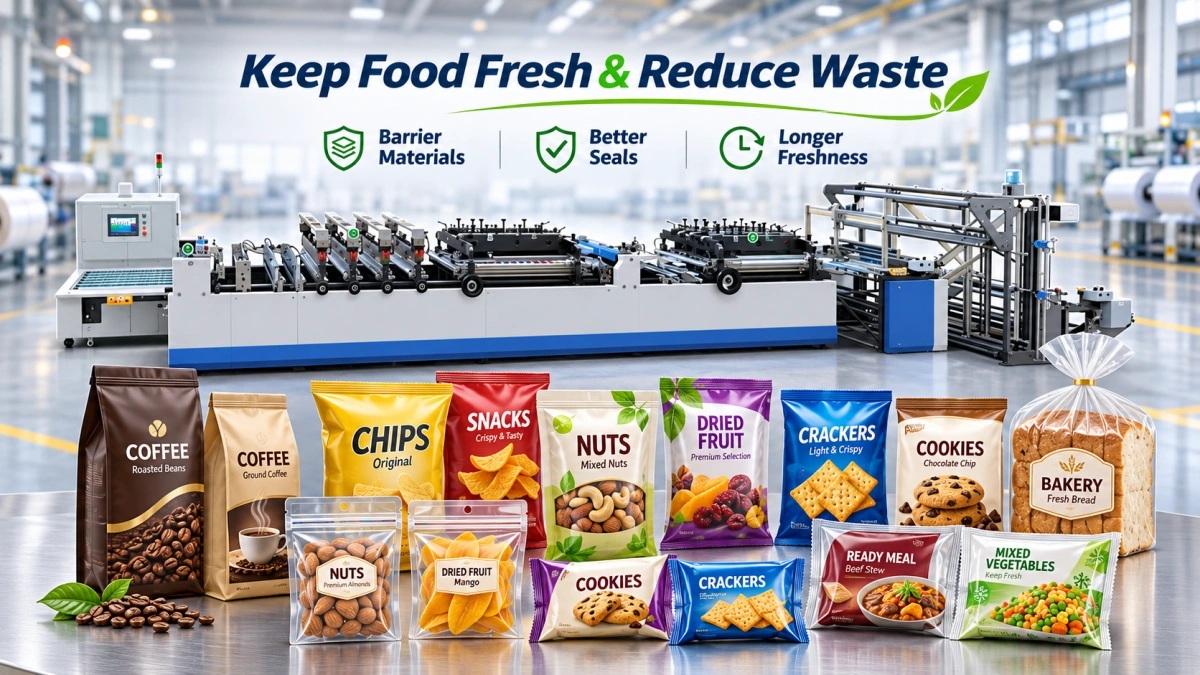
For example, a bag of crisps needs protection against moisture and crushing. Roasted coffee beans benefit from packaging that limits unwanted exposure to oxygen while managing gases released after roasting. Biscuits and crackers need packaging that helps preserve their texture.
Packaging also provides useful information, including ingredients, allergens, storage instructions, expiry or best-before dates, and other applicable product details.
However, no packaging material can keep food fresh indefinitely. Product formulation, hygiene, filling conditions and storage temperature remain important.
The goal is to choose packaging that provides the necessary protection without using more material than the application requires.
What Makes Packaged Food Lose Freshness?
Food freshness is affected by several environmental factors. Understanding them helps explain why different products require different packaging materials and closures.
Moisture Exposure
Dry foods such as crisps, crackers, biscuits and some powdered ingredients may absorb moisture from the surrounding air.
As moisture increases, products that should be crisp can become soft or stale. Suitable moisture-barrier packaging helps slow this process, particularly when the package remains properly sealed.
Oxygen Exposure
Oxygen can contribute to oxidation in susceptible foods, affecting flavour, aroma and quality.
Nuts, coffee and certain fatty snacks may benefit from packaging structures that limit oxygen transmission. Depending on the product, manufacturers may also use gas-flushing or other appropriate packaging methods.
Light and Temperature
Some foods are sensitive to light, while elevated temperatures can accelerate quality changes.
Packaging may provide a degree of light protection, but it cannot compensate for unsuitable storage conditions. A product that requires refrigeration must still be kept at the recommended temperature.
Physical Damage
Transport and handling can damage fragile foods before they reach consumers.
Crushed biscuits, broken snacks and leaking packages are examples of problems that suitable packaging design and careful handling can help reduce.
How Different Foods Need Different Packaging
There is no single packaging structure that works equally well for every food product. The right choice depends on the ingredients, desired shelf life, distribution conditions and the way consumers use the product.
| Common Foods and Their Packaging Requirements | ||
| Food Product | Main Freshness Concern | Packaging Considerations |
|---|---|---|
| Coffee Beans | Aroma loss, oxygen exposure and gas release | Appropriate oxygen barrier, reliable closure and a degassing valve where required |
| Crisps and Savoury Snacks | Moisture absorption, oxidation and crushing | Moisture and oxygen protection, suitable seals and package strength |
| Nuts | Oxidation, flavour changes and moisture exposure | Suitable barrier materials, secure closure and appropriate storage |
| Biscuits and Crackers | Loss of crispness and breakage | Moisture protection, controlled package dimensions and physical protection |
| Dried Fruit | Moisture changes, sticking and contamination | Material and closure selection matched to the product’s moisture requirements |
| Fresh Bakery Products | Moisture loss, condensation and microbial spoilage | Product-specific packaging, appropriate ventilation or barriers, and storage control |
The important distinction is that packaging should protect the qualities consumers expect from a particular food.
For crisps, maintaining a crunchy texture is essential. For coffee, aroma and flavour are important. For fresh bakery products, moisture management and appropriate storage conditions may be more relevant than simply selecting the strongest possible barrier.
A packaging material that performs well for one product may be unsuitable for another.
The Role of Flexible Packaging in Food Protection
Flexible packaging is commonly used for snacks, coffee, nuts, dried foods and many other products.
Unlike rigid containers, flexible packages use materials that can be formed into bags, pouches or other packaging formats. Depending on the application, these may include plastic films, paper-based structures or multilayer materials.
Flexible packaging can offer several practical advantages:
- Product protection: Suitable structures can provide barriers against moisture, oxygen or light.
- Convenient handling: Lightweight packs are often easy to transport, display and store.
- Portion control: Different package sizes allow consumers to buy quantities appropriate to their needs.
- Brand communication: Printed packaging communicates product information and helps shoppers recognise a brand.
- Material efficiency: Appropriate flexible structures can use relatively little material compared with some rigid alternatives, although the environmental result depends on the complete packaging system.
What Happens Before a Food Pouch Reaches the Shop?
A printed food pouch may pass through several manufacturing stages before being filled.
Depending on the product, these stages can include film printing, lamination, slitting, bag forming and sealing. Each stage must be compatible with the selected packaging material.
For example, a Flexible Packaging Machinery Manufacturer may supply equipment used for printing, laminating, slitting and converting packaging materials. Packaging producers then select the suitable processes, materials and equipment configurations according to the food product and package design.
Printing provides graphics and information, while suitable material structures contribute to barrier performance. Bag converting creates the finished package shape, and filling and final closure operations prepare the product for distribution.
These functions are connected, but they are not interchangeable. A well-printed package cannot make up for unsuitable barrier materials or a defective closure.
Why Bag Design and Sealing Matter
The way a food package is shaped and closed can be just as important as the material used to make it.
A coffee pouch, for example, may need a stable base for display, enough internal volume for the beans and a reliable closure. A small snack pack may prioritise easy opening, compact size and protection during transportation.
Choosing a Suitable Bag Format
Common flexible food packaging formats include:
- Three-side seal pouches: Compact flat packs used for suitable snacks, powders and portioned products.
- Stand-up pouches: Bags with a gusseted base that allows them to stand on a shelf.
- Flat-bottom bags: Structured pouches that can provide stable presentation for products such as coffee.
- Resealable zipper pouches: Packaging that can help consumers close a bag between uses.
- Side-gusset bags: Flexible packages that provide additional volume for suitable products.
The final shape of a food pouch affects how it is filled, transported, displayed and stored.
In industrial production, Food Packaging Bag Making Machines convert compatible films and laminated materials into finished bags through forming, sealing and cutting operations. The appropriate machine configuration depends on the bag design, material structure, dimensions and production requirements.
Why Seal Quality Is Essential
Even suitable packaging materials can perform poorly if the finished seals are damaged or incomplete.
For heat-sealable packages, seal quality depends on the material structure and the control of sealing temperature, pressure and dwell time.
Weak seals, wrinkles or contamination in the seal area may lead to leakage or loss of the intended protective barrier.
Consumers should also understand that a zipper is not necessarily equivalent to an unopened factory seal. Resealable closures may improve convenience after opening, but their ability to protect the contents depends on the design and how they are used.
For products requiring specific hygiene or storage conditions, consumers should follow the manufacturer’s instructions after opening.
Is Sustainable Packaging Always the Best Choice?
Consumers and food brands increasingly want packaging that creates less environmental impact. However, choosing a package based only on whether it uses paper, plastic or another material can overlook an important issue: food waste itself also has environmental consequences.
Growing, processing, transporting and storing food require resources. When food is thrown away, the resources used to produce it are also wasted.
This does not mean that more packaging is always better. It means environmental decisions should consider both the packaging and the food it protects.
Reducing Packaging Without Reducing Protection
For some products, lightweight packaging or a simplified material structure may provide adequate protection.
For others, removing a necessary barrier layer or weakening the closure may increase the risk of spoilage, leakage or product damage.
The appropriate choice depends on the product, distribution conditions, realistic shelf-life needs and available reuse or recycling systems.
Recyclability Depends on the Complete Package
Packaging made from multiple materials can be challenging to recycle where collection and processing systems are limited.
Likewise, packaging described as biodegradable or compostable may require specific conditions and suitable waste-management infrastructure.
Brands should avoid broad environmental claims that are not supported by the finished package’s actual composition and end-of-life options.
A practical approach is to minimise unnecessary material while maintaining sufficient food protection and making disposal or recovery information clear to consumers.
What Consumers and Food Brands Should Check
Whether you are selecting snacks for your household or choosing packaging for a new food product, a few practical checks can help improve freshness and reduce avoidable waste.
| Food Packaging and Freshness Checklist | ||
| What to Check | For Consumers | For Food Brands |
|---|---|---|
| Package Integrity | Look for damaged seals, tears or leaks. | Verify closure strength and package integrity. |
| Storage Instructions | Follow temperature and storage recommendations. | Provide clear, product-specific instructions. |
| Package Size | Choose quantities you can realistically use. | Offer formats suited to customer consumption patterns. |
| Resealability | Close packages correctly after opening. | Consider suitable resealable features where useful. |
| Material Protection | Keep food away from unsuitable moisture, light or heat. | Match barrier properties to actual product requirements. |
| Environmental Impact | Use available recycling or disposal systems correctly. | Evaluate material use, food protection and end-of-life options together. |
For everyday foods such as coffee, nuts, biscuits and snacks, small habits also matter. Closing packages properly, avoiding unnecessary exposure to humidity, and buying suitable quantities can all help protect food quality.
Food brands can support these habits by selecting packaging that is easy to use, clearly labelled and suited to the product’s actual freshness requirements.
Final Takeaway: The best food packaging is not necessarily the most complicated or the most expensive. It is packaging that provides the right protection for the food, works reliably throughout handling and distribution, and helps consumers enjoy the product before it goes to waste.
By balancing freshness, practical design, material efficiency and responsible disposal, food packaging can play a meaningful role in reducing avoidable waste while improving the everyday food experience.
Reference
[1] Food and Agriculture Organization of the United Nations (FAO). Reduce, Reuse, Recycle: A Mantra for Food Packaging. Published 29 September 2021.